Showing posts with label My cookbook. Show all posts

Sunday, January 3, 2010

Brataepfel - baked apples

One of simplest desserts and unguilty pleasures in the wintertime is this hot fruit assembly - here is one version I like a lot.

This also goes really well with Gluehwein.

Cut 4 apples in half and take the core out.
Fill each apple with raisins, powder cinnamon over them, and turn them upside down in a baking form. Add some raisins & cinnamon also between the apples. Add brown sugar over the apples, about two to three table spoons, and pour enough red wine (merlot works great, or a dry chianti) over it, enough to cover the bottom of the pan and somewhat the raisins, and add a few pieces of unsalted butter between the apple halves.

Bake this at 400 deg F for about 30 minutes.. and enjoy :)

The classical german version of this is typically without redwine, with whole apples without cores (cut out with a special core cutter), filled with raisins and sugar, mostly cinnamon, and sometimes hazelnuts, and also drizzled with honey.
In some parts of germany the Brataepfel are eaten with a hot vanilla sauce, in my home area rather on their own.

Friday, December 25, 2009

Apfelrotkraut - red cabbage with apples

Apfelrotkraut, or red cabbage with apple, is a great veggie dish to accompany my christmas goose.
These are some of the main ingredients: a nice red cabbage, one or two small apples, half an onion, a shallot, and a small wedge of celery root.


Cut up the vegetable, and add a bay leaf, three cloves, a couple of piment (allspice). Start by frying the onions lightly in some goose fat (coincidentally you might have some from that christmas goose you're making right now..) until they are softened but not browned, then add all the vegetable, salt, pepper, let it gain some heat, and then add a few table spoons of apple cider vinegar - I like that, because it adds to the fruitiness of the dish.
Let it simmer with closed lid until the cabbage is soft - it might take about 40 minutes to 1.5 hrs, depending on how much heat you're using. Which means you can optimize the timing to have perfect Rotkraut coincide with a perfect goose...

Christmas goose - Weihnachtsgans


Try this - classical german christmas birdie with classical stuffing - just to get you started, here is how it looks after 2.5 hrs of baking at 350 deg F:


But how did I get there?
If you start with a frozen goose, you might want to thaw it over night in water, i.e. have it in it's plastic bag in the sink covered in water. Mostly the package tells you how long this will take, but 12 hrs is a safe bet.

Take it out of its bag, drain it, wash it, take its innerds and the neck out, and cut some of the big chunks of fat off the orifices.

Here is a picture of the stuffing before it was baked: cut up
- a bunch of parsley,
- 3-4 small apples,
- half an onion and
- 3-4 shallots,
- 3-4 rolls or an equivalent piece of bread (I like whole wheat bread with good crust and lots of seeds). Mix in
- a cup to two of raisins, chop up
- the goose liver and add it, spice the whole thing with
- pepper and salt, and add
- 250 ml milk,
- 2 eggs and just mix it all nicely together. Smell it, it's already a whole pot of goodness and really nice.. :)Preheat the oven to 350 deg F. Put the bird in a pot that you have put some water in - enough to cover the bottom of the pot.
Stuff the bird with the apple mix, put the whole thing into the oven, and set your timer to 15-20 minutes - the reason being that you want to baste the bird with the juices about every 20 minutes. I put a thermometer into the leg too (typically you want it to reach 175 deg F), although with a stuffed bird that is not too helpful - I changed it later measure the stuffing temperature instead, also to reach 175-180 deg F.
At some point during the baking I add the stomach, heart and neck to the pot. They are done in about half an hour to 40 minutes. I just cut up part of stomach and the heart for my kitty cat and tested a little bit of the stomach myself. That makes for two happy predators in this house.. :)

Altogether, for my about 12 pound bird, it should take about 4 hours to be done - although that depends on whether you stuff it or not, and probably a little bit also with what.

I make Apfelrotkraut to go with this - also very typical for a german christmas dinner.
Merry christmas!

Saturday, December 5, 2009

Lime-Chili Baiser/Meringue

I'm in the mood for a lemony-spicy dessert - it's too cold for icecream - I'm not in the mood for creamy stuff anyway, and would like some kind of crunch experience.. and it should be something I have not tried before.

How about lime-chili-baiser?

Baiser (which you might know better as Meringue) are an unusual pastry, simply eggwhites wipped stiff with sugar, and baked until completely dry. In this case, for 2 hours at 266 deg F or 130 deg C.
Classically, they are used as a cake base, as baskets to be filled with fruits, as little desserts and ornaments.
In that sense, I'm doing a very classical thing here, just the flavoring is a bit .. unusual.
I used a zester to peel the skin of two limes:


The zest I put in a food processor with 225 g sugar, until the sugar has a lightly green tint and the zest shows up as little green speckles.
This I put in the fridge over night, first because I did not have time that night to finish the Baiser, second in the hope that the lime flavor would intensify with time.
Today, I wipped 5 egg white with the sugar until it was stiff:
Then I measured off little "dumplings" from this baiser-dough with two spoons onto a baking sheet, and baked them at 266 deg F for two hours. This is how they look afterwards:
Now, this was the version with pure lime, assuming that one cannot go wrong with this flavor, and having enough left over to mix with a chili baiser that would be much more risky..

Same procedure with the chili: I put half a red jalapeno pepper with 100 g sugar into the processor until the sugar was lightly reddish/pink. I removed the bigger chunks of pepper at that point, because the hotness will definitely intensify with time and baking. It should be a nice kick, not a punch in the face..

This sugar I whipped with 2 eggwhites, and lifted that carefully under the left over lime baiser - creating a red-green marbled baiser, that is limey and spicy and sweet. :)


Note to self - and you - the chili version needs some experimentation. Actually, zest of two limes for 4-5 egg whites turned out perfect, creating a wonderful lime smell and flavor, which turns down the sweetness a little and gives the whole pastry a real unique touch, to the point that you can eat lots of them without feeling sugared-out. Very very nice.
I think, next time I would add chili to that mix, rather than replace part of the lime with a pure chili-baiser, simply because the lime works so well, and the chili adds an accent which is very nice, but does not tone down the sweetness. My chili turned out too weak, you had a slight aftertaste, a light hotness in the background which was not bad but way weaker than I had intended. Next time - more chili? Cayenne pepper? The concept is great though, and the lime baiser are phantastic....

Monday, October 19, 2009

Crazy fusion

My friend says I am the craziest fusion cook he knows. Him being crazy himself, I take it as a compliment, and feel compelled to share what triggered his remark.

I wanted to cook something quickly. I had chicken. Spaghetti are fast. And I had fresh tomatoes from the garden of good friends. There are always onions and various spices around.
Simple.
But now about that madness aspect of it...
Take some garam masala and curry powder (or ingredients thereof of your choice), fry it in a little olive oil, add some chopped onion and black pepper, until the spices' smell reaches its peak. Then add the chicken (pieces of breast meat in that case) to brown it and get it happily accustomed to its flavoring friends. When the chicken is nice and brown, add some tomatoes, and to give it a little edge, some apple cider vinegar. Just a dash will do to bring out the tomato acidity a little better and contrast what is coming next: add the raisins.
Oh, I forgot that chili pepper I threw in with the spices for good measure.. but you probably thought of that yourself..And this is how this fused italian curry looks on spaghetti..
Oh, and what my friend means with "crazy" is "crazy good"..

Sunday, September 20, 2009

Kaesespaetzle

Previously I have described how to make Spaetzle, the egg noodles of various shapes that are typical for the german south, specifically Schwaben. But, once you got these beautiful noodles, what to do with them?
Traditionally they are a side dish to a sunday potroast with a nice dark gravy, or some other piece of meat with sauce - or you use them for Kaesespaetzle.

Here is how to do that:
you start with the simple stuff: grate some cheese. I typically use gouda, but this time I used a mix of emmental and gouda, to mix it up and give it a little more of an edge.

Chop up a big onion, or a couple of small ones, and brown them lightly in a pan, stirring a lot, making sure they get golden and soft, not crispy. When they are happy, set them aside.

Next, prepare Spaetzle: eggs, flour, salt, a little water (check back on my previous post for the details), scrape them off a board into boiling water, and set aside for what you got in store for them.

Set the oven to 400 deg F.
Find a big baking pan. Put a layer of spaetzle in to the pan, then a layer of onions, then cheese, then again spaetzle, onion and finally cheese again.
Let it bake for about 20 minutes (til the cheese is browned on top, don't take it out as early as I did here.. but we were hungry..), get the salad to go with it ready and enjoy traditional Kaesespaetzle!
My friend Dennis took this beautiful photo of the last one I made - next time I'll make it we'll see whether we get a shot of a cross-section.. :)

Monday, May 4, 2009

Potapigrapesagne

With all that talk about swine flu I got inspired.
Actually, that's a lie.
I just have a thing for pork in combination with all fruits I can find in my kitchen. Somehow it always works.

It may have to do with my mom's cooking.
It may be related to the sweet&savory combination dishes that are normal in Saarland.
Or it plain and simply just tastes good..

Here just quickly another example in the long list of fruity animals I have delivered at this site already -
olive oil in the pan, lay it out with potato slices. They fry a tiny bit, optimally to get them a bit brown (my impatience and hunger did not allow that to happen this time..)
Then lay thin pork cutlets on top of the potatoes, add a layer of grapes, then a layer of apple, throw some spring onion, thyme (generous!), black pepper and salt over this potapigrape-sagne, cover with a lid, set to something in the medium range and walk away.
Eventually, come back (I would suggest after 15 minutes; smell-driven also earlier).This is one of those dishes that you will keep in your list of quick and dirty yet amazing. Promised. :)

Sunday, April 19, 2009

Frozen easterbunny special

This is the last of this year's easter presents:


Easter ice cream!

Take 200g carrot puree, add some lemon juice (probably 1-2 table spoons) and 150 g sugar. Adjust the flavor with a little bit of maple sirup, and mix 1/8 l heavy cream into it. Cool that mixture down in the fridge, and when it's cold, stir it well again (or don't if you'd like it to be orangy-marbled) and pour it into your ice cream machine. After 20-40 minutes you should have some beautiful creamy carrot-bunny-easter-special ice cream, that you can serve with caramelized walnuts.

Keep in mind - I have not yet tried this recipe myself (I create to many recipes and can't keep up with testing them..).
Depending on your taste & how sweet your carrots are you might have to play a little with the proportions, but based on my icing-experience this should make a real cool easter treat :-)

Saturday, April 18, 2009

Introducing: Icecream Madness

Last week I had a visitor, Christian, who loves ice cream and always discovers the newest, strangest and most delicious ice cream creations in the freezer section, local ice creamery and private cookbook of secret ice creamers.. When I saw him last, he introduced me to Pomegranate-Chocolate, which is outstanding. This time, in Nashville, there were no really wild things to be found, but we ate lots of ice cream anyway...

This morning I remembered that there is one ice creamer in Nashville who is really crazy. She designs ice cream that no one has ever heard of, creations so utterly unspeakable that I have to talk about them here, starting now, tasting soon... Without further introduction:

Welcome to the new section of TasteBuds: Icecream Madness!, by Elin

My ice cream inventions date back to my first ice cream maker, obtained as a gift from my dear & master-chef mom in 1996, I believe. Maybe christmas 1995. A while ago.

I started simple: lemon ice cream, the most difficult and complex of the simple flavors that I know of. I tend to eat lemon ice cream in any ice cream store, first thing, to find out how they do it, what their philosophy is about and whether I wanna steal their recipe..
After years of making cream, yoghurt, and buttermilk based lemon flavors I figured that it is one of those things that one day I will discover perfection and die with heavenly lemon ice cream on the tip of my tongue.
So, I haven't tried anymore, I'll start again maybe when I turn 80 or so.. just in case I'm right.

After the first lemon, I became inventive. Some of it is actually quite good, although opinions varied about the smoked trout ice cream on horseradish whipped cream..

I wrote my private ice cream cookbook (and one I gifted to my mom a few years back, with pencil drawings of each recipe), containing some tested and lots of never realized recipes, ranging from classic sweet to savory, from standard compositions to crazy concoctions - be prepared, they will make their entrance into the world on online cooking.

Now.

:)

Saturday, April 11, 2009

Easterbread

Happy easter!
As you can see, the easter bunny dropped in for a visit!
..and, no, this is not my cat but some poor kitty that could not fend of his/her can-opener's silliness and ended up engraved as feline easter bunny in the net.


Eastern in Germany is still a big holiday, actually the most important one after christmas. People visit family, children receive gifts, there is a lot of cooking and eating, and most of this is still somewhat traditional, at least there is a common framework to it all.

And it starts with breakfast (let me skip Karfreitag etc. which is not commonly observed, unless church is involved, and go straight for the good food..)
Besides the religious aspects of it, Eastern is a holiday that revolves around symbols for renewal, fertility and spring. Easter sunday starts in that spirit with a special breakfast, sporting more eggs and presenting them much nicer than usual.

Traditional easterbread dough is braided around hardboiled eggs and then baked - so your first food will be fresh, warm bread, from white flour, sometimes with raisins, very light and fluffy, typically with a crunchy crust - but also an egg, perfectly held in place by the bread like in a little basket, sometimes painted before baking.

German breakfast typically consists of bread, butter, sweet spreads such as marmelades and honey, boiled eggs, and sometimes sliced sausages/salami/ham and cheeses. Thus, while the general notion of bread, egg and things for a sunday breakfast is not out of the normal, the specialty about this breakfast is the presentation as well as the recipe for easter bread itself.

From the above bread version one makes typically one for each person at the table; but the larger part of the breakfast bread will be coming from this:


In my case, this is the same dough recipe as the egg-basket, only that this bread is braided and bigger. It is a yeast & white flour dough, with milk as the main liquid, some molten butter & eggs (about 3 eggs for 700 g flour). Typically it has a little bit sugar in it as well, and sometimes raisins; I added flax and sunflower seeds. The proportions of liquid to flour depend on how your flour behaves and on the size of the eggs - start with 1 cup or ~ 250 ml liquid, but be prepared to double that as you need it to be able to shape the dough but not have it stick to your hands like wet clay.. I typically warm up the milk with some sugar (~ 100g) and butter (about a stick, i.e. about 125 g) and then stir in my dried yeast and let it go for a little while. Dry yeast does not need that treatment, but it smells awesome..
Treat it like a normal yeast dough - let it rise, knead it, and give it some warmth and time before shaping it into the braids.
Brush it with egg yolk mixed with a little bit water, and bake it at 350 deg F for 50 minutes.

And then: have a wonderful breakfast!

Carrots for the easter bunny

Where there is an easter bunny there must be carrots.

While this is not a real traditional saying, there is certainly truth to it. During the easter holidays, carrots show up in form of Marzipan treats, as sugary decoration on pies, and, most importantly, in the carrot cake.

My version, as almost any other I've ever seen, has a combination of all, sugary, marzipany, and real veggie carrots to make sure the bunny gets plenty of vitamine A..

The recipe is based on a simple cake batter: equal parts (weights) flour, sugar, butter & eggs are mixed together, with some baking powder. To make it a carrot cake, one essentially replaces the flour with carrots, and, adds typically ground almonds, or, what I like a lot, ground walnuts. Either tastes great. I usually use 300 g each, and instead of 300 g flour I'd use 250 g finely shredded carrots + 50 g flour + 100 g walnuts. I also replace the usual white sugar with brown sugar, and some dark honey.
All that will make a thick flowing batter that is baked at 375 deg F (170-180 deg C) for about an hour.
The decoration, as seen on my cake on top, is easily made by squirting bought colored frosting onto parchment paper. Try to squirt it on in carrot shape to begin with, but it can be formed using a wet finger. Let it dry, and let the cake be cooled down before moving the deco carrots onto the cake..


Only with such a cake to hope for, the easter bunny may be in the mood to lay those nicely colored eggs in the carefully prepared nests which we as a kid still had to build from moss that we collected around the house. A nice, soft, green nest that would be filled the next day with eggs and chocolate and all kinds of cool things a rabbit could carry on his back...


Coloring eggs by the way is real fun, and can be done in very natural & creative ways - for example, onion skin is a good coloring agent - wrap the eggs in several layers of onion skin, tie it up with some thread and boil it - use yellow and red onions for different colors. Wrap the eggs first in textured cloth, then surround that by onion, or blue cabbage, and boil it - the egg will have a nice texture, showing the structure and boundaries of the cloth wrap.
However, buying coloring agents will help you to those very strong colors, of course. Onion peel is not quite that potent.

If there are kids around, I leave a little dough of the carrot cake out before the carrots are added, and bake it as two cookies that are flown together - when it is done, I carve out ears from the one "cookie", paint a face on the treat and glue it into a small nest that I made from green frosting. You can even "glue" some little sugar eggs into the nest, that also helps stabilizing the cookie bunny standing up.

After all that carrot cake, that makes one real happy easterbunny! :)

Friday, December 26, 2008

The cheap (and easy) way out

My Flammkuchen was not standing under a perfect Flammkuchen-star...
I don't have the special oven, did not have time to make the dough, and most likely a vegetarian coming over. So, no bacon. No bread dough. No really high heat.

[Here is a recipe for the real thing]

Note that Flammkuchen is not really german - it is from Alsace, i.e. a french region at the border to Switzerland & Germany.

Here's the cheap trick for the veggie-version:
I bought crescent dough - a little too sweet, true, but works; roll dough or pizza dough might be better but I wanted it a little flaky. Just because I felt like it.
Rolled it out on a sheet. Mixed sour cream with cream to add fat (for baking that's better, it crumbles otherwise, said my mom. And she knows these things..). Peppered and salted it. Sliced onion, boiled it shortly in water, then mixed it with walnuts and grape quarters.
The sour cream covers the dough, the onion-grape-nut mix is sprinkled over it, and all that is baked for about 15 minutes at about 375 deg F (or whatever your dough would like to be baked at).
It's a really nice, simple, quick version of vegetarian Flammkuchen!


Another veggie-pizza-like item is this here: I simmerd spinach with butter, mixed roasted sunflower seeds and dried tomatoes in, and ricotta. Salt and pepper, and cover the pizza dough of your preference with


Both are quick and easy, and, obviously, versatile. The spinach-ricotta mix is my favorite, the dried tomato gives it a real kick.

Good stuff. :)

Red earth

Red beets are a knockout if you're into earthiness - and red fingers after prepping them. Other people spend money on Henna, so, well..

But: they may sometimes be a little too much for some people, it's a matter of taste, as (nearly) everything.
Here is a recipe that lightens up the heavy flavors, adds acidity, gives the earth an airy lightness and an edge that leaves you wanting more.. (thanks mom!)

Fry the beets from all sides a bit in butter, salt them, put the lid on & let them simmer for 20-30 minutes - check on whether they are done. Then, add a spoon of honey, and some balsamic vinegar. Mix well together, and add vinegar til the taste is right. The beets drink the Balsamico up like nothing. Finally, add slices of orange - I used tangerines.
Delicious combination.

It goes really well with duck, ...as in sophisticated dinner vegetable.. as in christmas..

Saturday, December 6, 2008

Christmas cookies

It's time to get started, seriously. December 6th and no single christmas cookie baked yet? Unbelievable...

But, here we go, the first badge of cookies, quite a selection of quickly whipped up little critters that will disappear in no time, but remind me on how easy it is to make these things, if you're simpleminded like I am.. :)
There they are:
- chocolate cookies ("Schokoladen Prasselplaetzchen"), some covered in hazelnuts, some in sugar
The recipe is from a Chocolate cookbook from teh Bechtermuenz Verlag: melt 200g dark chocolate with 90g butter, add 115g sugar and vanilla, beat in 3 eggs, and then add 200 g flour with 1/2 tea spoon baking powder, and a little salt. They ask for 25 cocoa powder as well, which I did not add. Let the dough sit cold for a bit before you form it into little balls, roll them in ground hazelnuts, or powder sugar, and then bake them for 10-15 minutes at 160 deg C (320 deg F).

- hazelnut macaroons
I had some leftover eggwhite, added sugar and hazelnuts, and baked it at 400 deg F for about 10 minutes.

- coconut cookies
These are not quite macaroons because there's egg yolk in them - that's why they are so yellow. Temperature is about the same as for the hazelnut macaroons.

- Spekulatius cookies
These are based on flour, baking powder, sugar, egg, a little heavy cream, and, spekulatius spice, which contains cinnamon, orange and lemon peel, cardamom, cloves, coriander and nutmeg.

Spekulatius is actually a traditional central european christmas cookie, which is entirely different from what I made here - I just threw somewhat randomly things together that result in something with a good taste and a cookie appearance, and coincidentally I had Spekulatius spice to add to the mix :-)
But here's how real Spekulatius looks like:
Check out this recipe for Spekulatius (supposedly belgian, but they are very similar in Germany), a little more work than I was willing to put in today.. but well worth it!

Happy Nikolaus-Day!

Saturday, November 29, 2008

Fruity animals

To continue with the fruit-meat combinations, here another one I made quite a while ago:
Pork-apple stew
This is based on onions seared to being soft & golden, and pork pieces fried to have some color; at that point I added pieces of good textured apples, fried them a little bit as well, spiced it all up with a dash of cayenne pepper, and lastly took the heat off with cider vinegar, adding more fruity acid and giving it the final kick.
Simmering that cider vinegar away to have everything blend together gives you the chance to adjust how sour it tastes - some of it will cook off, but don't forget that the Cayenne pepper gains in power as you cook this longer...

A good idea is also to move this a little more in the indian corner, by starting to fry onions with cumin, turmeric and coriander seeds, and maybe some fenugrek, which adds a almost meaty flavor to the whole concept. Less acid in that case is key, but more cayenne might be good.

Any other interesting meat & fruit ideas? Let me know!

Tuesday, November 25, 2008

Cordon vert

My last night's dinner reminded me on another variation on the theme of fruit, pork & cheese.. Cordon vert.
No worries, you have not forgotten anything essential, I made that one up. Still good.

A dish very typical for rural area german restaurants is "Cordon bleu" (blue ribbon, supposedly not named after the culinary school, but after the blue ribbon of excellence), also common in Austria, I assume. It is veal cut open and filled with cheese and ham, battered and fried, similar to a "Wiener Schnitzel", just stuffed, as can be seen on the right.


My "cordon vert" (green ribbon), first of all, is with pork, i.e. makes the ham obsolete, is not battered, has a different cheese (correct, my alltime favorite gruyere), and is green, because it contains fruit/veggie matter. The upscale healthy choice, sort of.

This is before frying it:Pork cutlet or pork chop without bones, filled with apple slices and gruyere, fried with black pepper, parsley and spring onions.
This is it when it's done, ready for the happy eater:
Enjoy :)

Monday, November 24, 2008

Himmel und... heaven too

Do you know "Himmel & Erde"? It is a traditional german dish with potatoes and apples. Enough said, happiness included.
There is something else going in that direction, combining potatoes & pears - no discussion there either. Yum. (Does anyone know that dish under some name? Am I making that up? No matter, tastes great..)
One step further: add gruyere to the above. Okay? Easy, that is basically nothing else but a traditional Raclette (with gruyere instead of raclette cheese, admittedly): hot potatoes, good cheese molten on top, pear in some form (admittedly, not in Eau de vie form, but that is a very good candidate for accompanying or following this dish).

Yes?
Oh, yes...
Here is today's heavenly dinner:
starting with olive oil, one layer of sliced potatoe, chopped onion, garlic, nutmeg, salt, & black pepper.
Next layer: fried pork chop cubes.
next: pear, in this case fresh from my friends garden, i.e. locally & organically grown, and so tasty on their own..
Then: sliced/cubed gruyere (Kaltbach, i.e. aged in a cave, that is the reserve of gruyere... imagine that!)
Bake it for 25 minutes at 400-420 deg F (or til it smells amazing & the potatos are soft).
This is how it looks then:Himmel, heaven, and then some..
bon appetit :)

Tuesday, November 4, 2008

Election Spaetzle

What better than making and eating Spaetzle on this election night, while listening to npr and watching the NYTimes statistics crawl higher and higher on the blue side of the political spectrum.. I'm optimistic, & hungry, and I have leftover from last night that is perfect for this, so - Spaetzle it is.

First, a little background: Spaetzle is a very traditional staple food of southern Germany, Switzerland and Austria. Spaetzle are essentially egg noodles.

The main ingredients are flour, eggs, sometimes a little water, and salt. The major fluidity of the dough comes from the eggs. Consistency and texture of the dough depend on how the Spaetzle will be finally shaped.
There are three ways to get them into the boiling or simmering water:
they can be scraped from a wooden board, that's what I did tonight.resulting in thicker, lengthy, very irregular shaped Spaetzle. This requires a thicker dough as shown in the photo of my tonights dough (that did not include any water) almost like a dumpling dough.
Or they are pressed through a Spaetzlespresse, resulting in longer and thinner Spaetzle that resemble more typical noodles (needing a more liquid dough), or, lastly, they are scraped through a device called Spaetzleshobel (this dough is typically the most liquid of all three), resulting in small Spaetzle-blobs, called "Knoepfle" (little buttons).


The Spaetzle need to hang out in the simmering/boiling water til they start to rise. At that point they can be lifted out and added to a bowl of already waiting Spaetzle-friends..

Adding a little bit of butter to that bowl helps them not caking together. Also, draining them well after lifting them out of the water makes them more easily separateable.

At this point you can (and I do) dive in and eat the hell out of them.. they are sooooo good. And so easy to do..

The Spaetzle idea came to me last night, actually, but after making the "sauce" I had intended I was too lazy for Spaetzle-making. But, there is plenty leftover, and this is what it is: a little stew from veal, dried porcini, and carrots, with onion, and fresh herbs from my garden (thyme, rosemary, sage, a little lavender), as well as bay leaves and juniper berries to get the whole thing a little bit a hint of game..
This is how it looked last night :-) And this is how it looks with Spaetzle :-D
What a difference.. !
The polls look like Pennsylvania and Ohio go to Obama, which means I'm stuffed & tastewise happy, but also politically quite a bit more relaxed.. optimism paid out, the celebration Spaetzle turned out amazing and so did the context.
Now I need a Schnaps :)

Friday, October 24, 2008

Insalata germanica

As a follow-up to the Oktoberfest post, I would like to highlight a few more german dishes that were featured at the fest (as sides to the staple dishes), but never make it into the major news - that has to end.


Kartoffelsalat Bacon pieces and onions are fried to golden/crispiness. Add some plain vinegar, and, after this does some sizzling action, also beef stock, and maybe some fresh parsley - this whole happiness is poured over boiled and cooled down, sliced potatoes. Mix well and store cool for a couple of hours or over night.
The dressing will soak in to the potatoes and will add to the potato salad the appeal of fried potatoes with bacon - together this is a refreshing, hearty dish that can be a centerpiece to remember.
At the recent Oktoberfest, people were raving about this salad made by the hosts after their either bavarian and saxonian recipes- when I made it in the past, especially americans were really intrigued by it. Some, because it reminded them on what their german grandmother used to make, others simply because. Not surprising to me :-)


Bohnensalat mit Gurke salad from steamed green beans, with cucumber slices and white onions - very lightly acidic with plain vinegar. The beans typically need a little more salt than other salads, in my experience. Actually, I have never had this with cucumbers in it and found it to be a really nice summery take on the very common german green bean salad.


Gurkensalat
Cucumbers are sliced thin and mixed with a dressing made from heavy cream, a pinch of salt, maybe a little white pepper, where I grew up also lots of dill, and white, plain vinegar. Be courageous with the vinegar, the acid helps the cucumber taste standing out and makes this not just a side dish, but elevates it to a standalone that is great, cool and fresh on a hot summer night.

This salad, as the above as well, improves immensely from sitting for a couple of hours - the vinegar gets to better extract all the goodies from the other ingredients, the dill distributes its aromas, and the cucumbers have more time to penetrate the cream with their flavor. It's so good..

Actually, with all these salads, acidity is a really important tool - the potato salad, for example, changes attitude entirely when you give it some sour edge, it gets so much more than just cold fried potatoes with some bacon on them..

Strudel & Streusel

What would a real german party be, after all the serious staple foods, piggly, salads and the such, without ending on a sweet note? It would simply not be.

Here is the outline of the dessert list of the recent Oktoberfest that I was lucky to be invited to:

- Kirschstreuselkuchen
- Apfelstrudel
- Bundtkuchen

Lets do a little language lesson:
Streusel [ˈʃtrɔyzl̩] (pronounciation) can be translated as granules or crumbles. You can see the crumbles on the pictured pie, that actually looks very similar to the Kirschstreuselkuchen at the Oktoberfest.


Streusel recipe
Streusel are made like this: use
- 150 g butter
- 150g sugar
- 200 g flour
Mix it all together with the butter being somewhat warm but not molten, until the mix turns crumbly. You can mix it with your hands or longer in the food processor to make thicker Streusel.
Sprinkle them on top of your cake or pie before baking and they will be a great crunchy, yummy topping that is often more enticing than the cake itself... as a kid I was often stealing the Streusel from the simple Streuselkuchen, because they were the best part of the whole thing..

Strudel [ˈʃtru:dl̩] (pronounciation), can be translated as vortex or swirl, or maelstrom. Maybe you can see how the dough & filling swirl inside this beauty?


Strudel is a pretty complicated and labour-intense pie; here you can find a very detailed and pictured description about that process. I tried it myself once, the Topfenstrudel variety (more commonly known is Apfelstrudel), and had in the end a big clump of dough next to a big clump of filling in the oven. It tasted amazing, though..


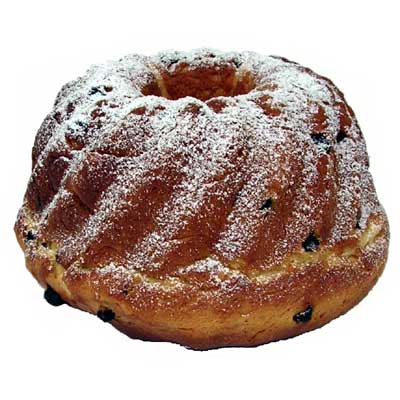
Bundtkuchen - this cake is named after its shape, and the pan it is made in, the Bundt-pan (see a picture of the cake below). It is often also called Guglhupf, which is not entirely correct - the Guglhupf pan results in a slightly different looking cake, as you can see on the right. It also is typically made with a yeast dough, which, to my knowledge is not true for Bundtcake.


The cake at the Oktoberfest was more in a Bundtcake shape, and was actually a chocolate cake based on a "Ruehrteig" (german for stirred dough).

Ruehrteig recipe
Mix
- 300g flour,
- 300g molten butter,
- 300g sugar,
- 300g eggs (about 5-6 eggs).
together to a smooth dough (molten butter comes last). You will notice that at first it is very fluid, but gets thicker with time. You don't want to stir it too long or it will turn greyish and a little too tough.
Add
- 50-100g cocoa powder
to the dough, maybe add some chocolate chips. Essentially, just get the taste of the dough right to your preference - some like more cocoa (me!), some less.
Pour this dough into whichever shape pan you prefer, and bake it for about 40 minutes at 425 deg F (about 220 deg C).


This base dough is very versatile, you can put anything in it. For example, replace a third of the flour with roasted ground hazelnuts, and add a little bit of rum in the end.
Or mix in pieces of 1-2 cubed apples and a cup of raisins, and a teaspoon of cinnamon in the final dough, and batter the pan with sliced almonds.
Or mix half of the dough with cocoa powder, pour the white dough into your baking pan, pour the chocolate dough on top, and swirl the two doughs into another using a fork - there's your classical marble cake.

The possibilities are endless.
 
Blog Flux Local - Tennessee Add to Technorati Favorites Bloglisting.net - The internets fastest growing blog directory blogarama.com